GOOGLE has unveiled Gemini 4 Argon, described as a frontier AI model built for coding, enterprise work and autonomous cybersecurity defence. The company is rolling Argon out first to a trusted cohort through its Fairwind Program rather than a public release. Pricing starts at $2 per million input tokens and $10 per million output tokens, with cached inputs offered at a 95% discount before higher rates apply; notably, Argon increases the output limit to 1 million tokens, up from 64,000 in the previous generation. Google’s publication states this headroom enables the model to reason over long, complex problems in a single trajectory.
Google says Argon is already used internally by its engineers, delivering tangible improvements: quantum computing researchers reportedly cut a resource-heavy process’s duration by around 40%, and analysis of data-centre data uncovered memory optimisations that freed more than 300 TiB, with an estimated additional 500 TiB to 1 PiB possible.
Argon is also being employed to rewrite C and C++ code into Rust, including work on the Fuchsia Zircon kernel and the libgav1 video decoder, where the updated Rust version runs approximately 2.7 times faster while maintaining the same output and memory safety. In benchmarks, Argon reportedly scores highly across several domains, including long-horizon software engineering, finance and legal tasks, and video understanding.
On the security front, Google notes that Argon operates with reduced cyber safety restraints for trusted security teams and Google’s own staff, enabling it to actively search for vulnerabilities defenders can fix. The company reports that Argon demonstrated the ability to identify a critical flaw in healthcare software via its Wiz collaboration and scored well on CWE-bench and related evaluations.
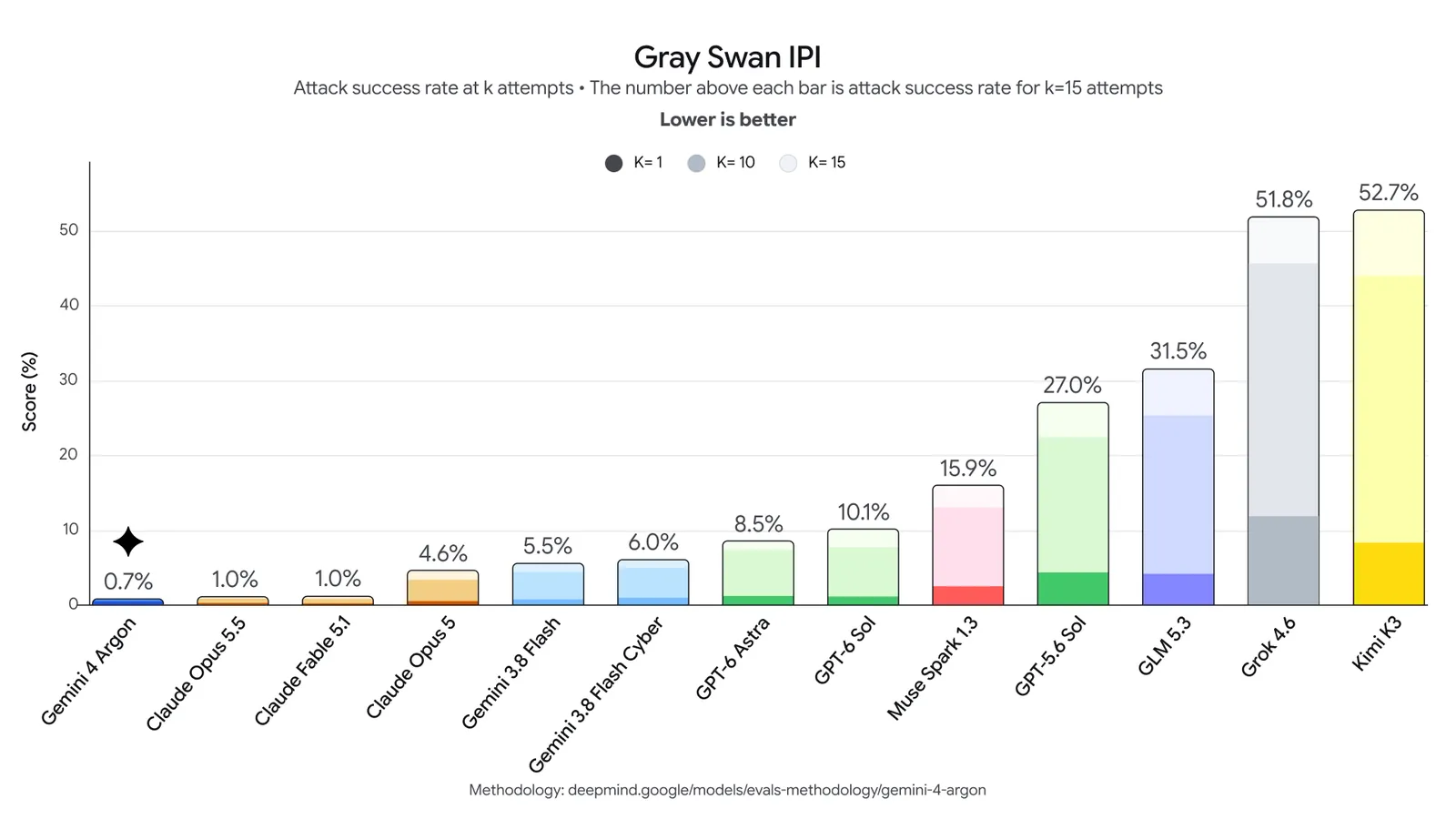
To mitigate risk, Google outlines four defensive pillars: preventing misuse for cyber or CBRN purposes, strengthening resistance to indirect prompt injections, and isolating training and testing sandbox environments. The model’s chain-of-thought and actions are monitored in real time, with execution halted if the model deviates from user intent, and results are not fed back into training to avoid teaching the system how to circumvent safeguards. 1 October 2026