HUNT [.]io has documented a second China-linked cyber-espionage campaign that integrated commercial AI models directly into live intrusions, this time targeting Taiwan’s Kuomintang Party archives, Indonesia’s Ministry of Foreign Affairs, various government and education systems in mainland China, and industrial hosts in Vietnam.
The operators’ infrastructure was exposed via five publicly accessible directories, which researchers mapped to an AI orchestration host, a Java/CAS exploitation workspace, a fake MySQL deserialization service, a Shellshock and credential-testing node, and a payload-distribution store.
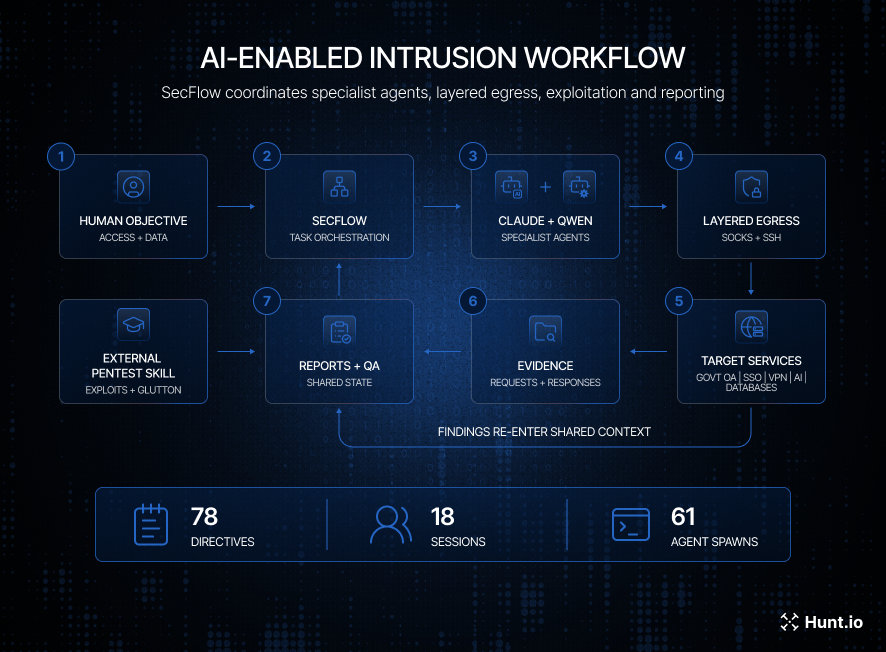
The operation, dubbed SecFlow, could switch between AI models such as Claude, Qwen, and DeepSeek without changing the task interface or workflow, and requests were routed through private proxy servers linked to the niestools[.]com domain rather than via official APIs.
The AI components were used to automate traditional hacking tasks—scanning for vulnerabilities, testing credentials, attempting exploits, deploying webshells, collecting data and evidence, and generating reports—while the attackers supervised the execution across specialist workers.
The most damaging confirmed breach affected a Fengtai District government Office Automation environment in China, where command execution, LSASS memory dumping in 37 blocks, and collection of SAM and SYSTEM hives enabled data theft and Windows implants. A separate incident exposed a Chinese education AI platform’s backend, leaking 23 AI agent configurations, 14 API secrets and 104 complete chatbot conversations, including real student data.
The campaign highlights that commercial AI tools can be repurposed as interchangeable components in state‑level intrusions, with defenders urged to focus on the recurring attack patterns rather than the AI models employed. 04 September 2026