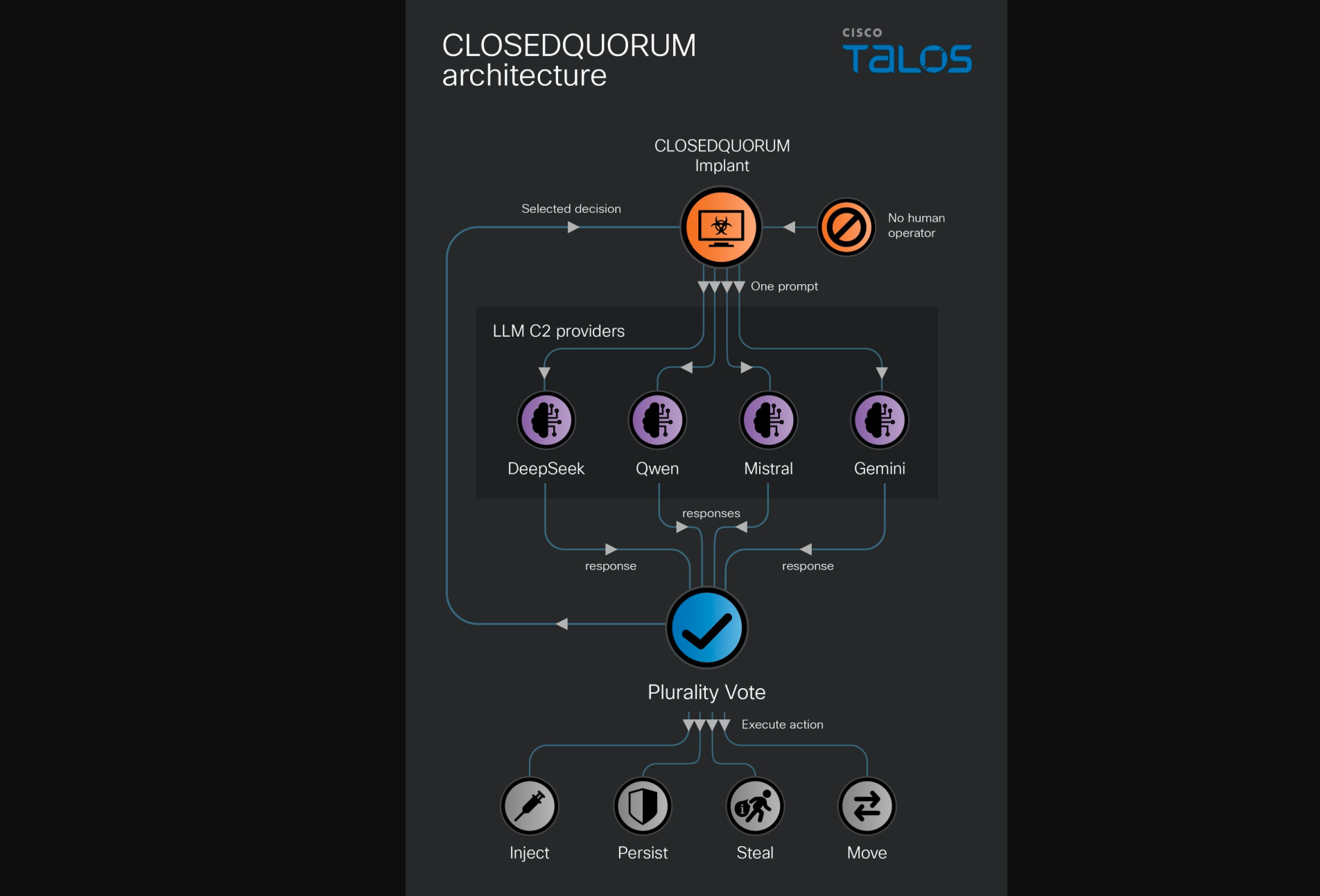
CISCO Talos has reported a Windows malware implant called CLOSEDQUORUM that uses commercial large language model (LLM) services as command-and-control infrastructure. The 16.4MB, 64-bit executable, written in Go with C components, collects the host name, processor count, operating system version and administrative privileges before sending the information to four providers: DeepSeek, Qwen, Mistral and Google Gemini.
Each model selects one of four actions — inject, persist, steal or move — and the malware uses a voting system to choose the operation, with DeepSeek preferred in a tie.
The public sample is described as an inert distribution template: its provider credentials and communication endpoints contain placeholders, so Talos has not confirmed infections in the wild. Development builds reportedly support customised binaries containing buyers’ API keys and webhooks, although the article says the developer’s suspected links to carding forums are based on evidence from posts dating back to 2025.
If the steal function is selected, CLOSEDQUORUM can inspect LSASS memory, collect saved browser passwords and cryptocurrency wallet keys, encrypt the information with rotating keys, and send it with decision logs to Discord.
Talos recommends looking for processes that contact several AI-provider endpoints while also inspecting memory or injecting into processes. Defenders should also restrict access to authentication-subsystem memory and monitor unexpected Discord webhook traffic, since conventional domain blocklists may not identify communications with legitimate AI services.