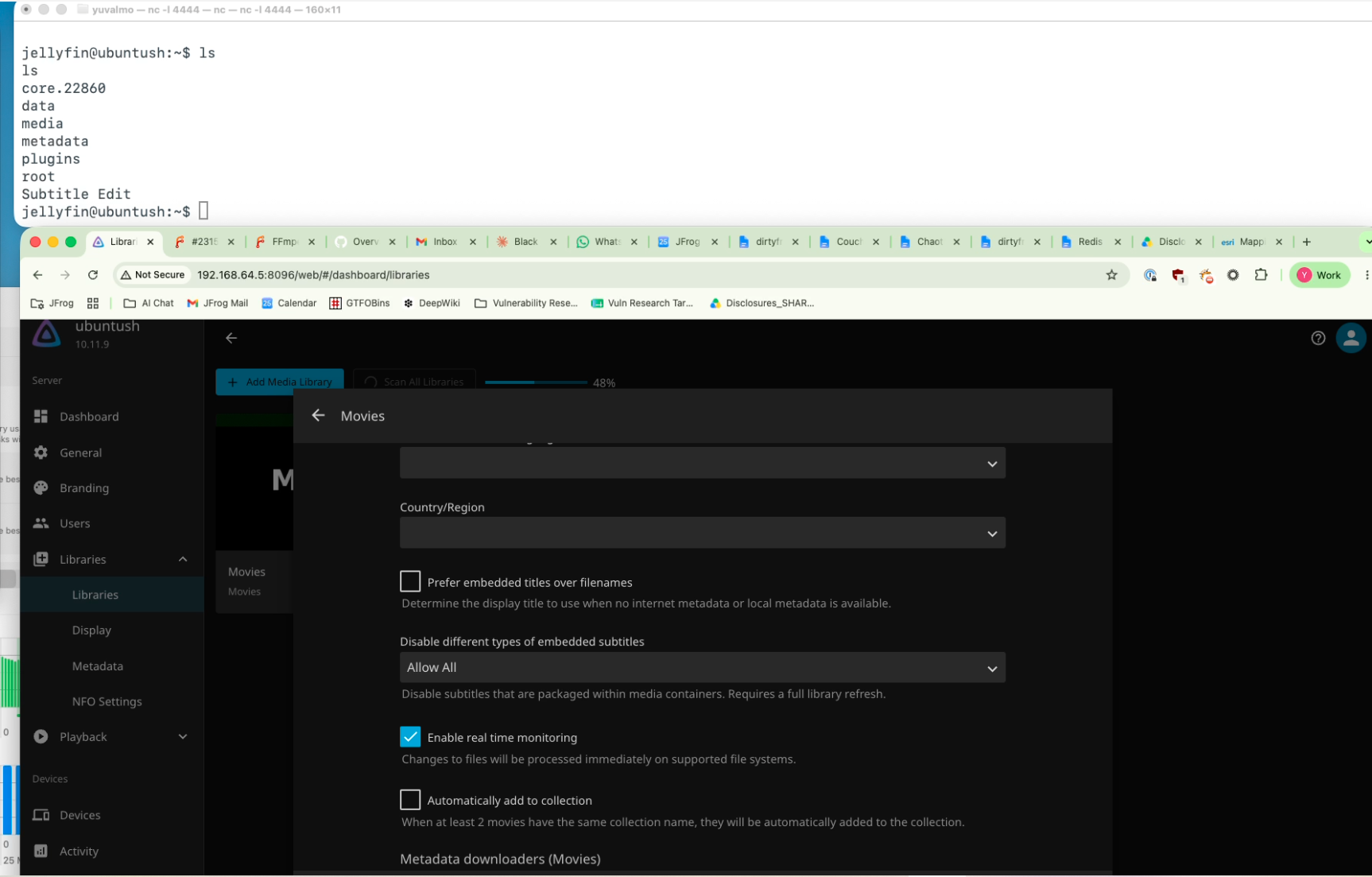
A flaw in the FFmpeg MagicYUV decoder has been revealed as a path to remote code execution when malformed video files are processed. Tracked as CVE-2026-8461 and given a CVSS score of 8.8, the bug lets attackers hide executable payloads inside AVI, MKV or MOV containers that trigger the vulnerability when decoded. Malwarebytes reported that the issue impacts millions of Linux systems that rely on FFmpeg for thumbnail generation or media serving, including those running Jellyfin, Nextcloud or network attached storage appliances. Security researchers have dubbed the problem PixelSmash.
The vulnerability resides in the libavcodec component where the MagicYUV decoder incorrectly calculates memory for frame allocation and mishandles chroma plane heights. By crafting a video file with specific malformed dimensions, an attacker can cause an integer overflow or buffer overrun that leads to arbitrary code execution with the privileges of the process invoking FFmpeg. No authentication is required; the exploit works when the file is opened by any application that calls the vulnerable decoder, such as a media player, a streaming server or a thumbnailer service. SecurityWeek noted that the underlying error has been present in FFmpeg releases prior to version 8.1.2.
Systems that use ffmpegthumbnailer to generate previews, media servers like Jellyfin that transcode uploaded content, and Nextcloud instances that store and preview videos are especially exposed. Embedded devices such as NAS appliances and smart TVs that bundle FFmpeg for media playback also inherit the risk because they often ship with older library versions.
The flaw is not limited to a single distribution; any Linux‑based environment that has not updated its FFmpeg package since early 2026 is potentially vulnerable. The wide deployment of the codec in both desktop and embedded contexts amplifies the possible impact.
To date no threat actor has been publicly linked to active exploitation of CVE-2026-8461, and the vulnerability is not listed in the Known Exploited Vulnerabilities catalogue. However, the proof‑of‑concept code demonstrated by researchers shows that a specially crafted media file can crash a target or drop a shell without user interaction beyond opening the file. The ease of delivery, via email attachment, download link or uploaded video, means that the flaw could be quickly adopted in opportunistic campaigns if left unpatched.
Mitigation begins with upgrading FFmpeg to version 8.1.2 or later, which contains a fix for the improper allocation checks. Administrators who cannot update immediately should consider disabling the MagicYUV decoder at compile time or via runtime configuration to prevent the vulnerable code path from being used. Reducing automatic video processing, such as turning off thumbnail generation in file managers or limiting media server transcoding of untrusted uploads, also lowers the attack surface. Monitoring logs for unexpected decoder crashes or segmentation faults can help spot exploitation attempts early.
Defenders should prioritize patching affected systems as part of their regular vulnerability management cycle, testing the update in a staging environment before rollout. Where immediate patching is not feasible, applying application control policies that restrict which binaries can invoke FFmpeg adds an extra layer of defence. Finally, educating users about the risks of opening unsolicited video files, even from known sources, complements technical controls and helps reduce the likelihood of successful payload delivery.