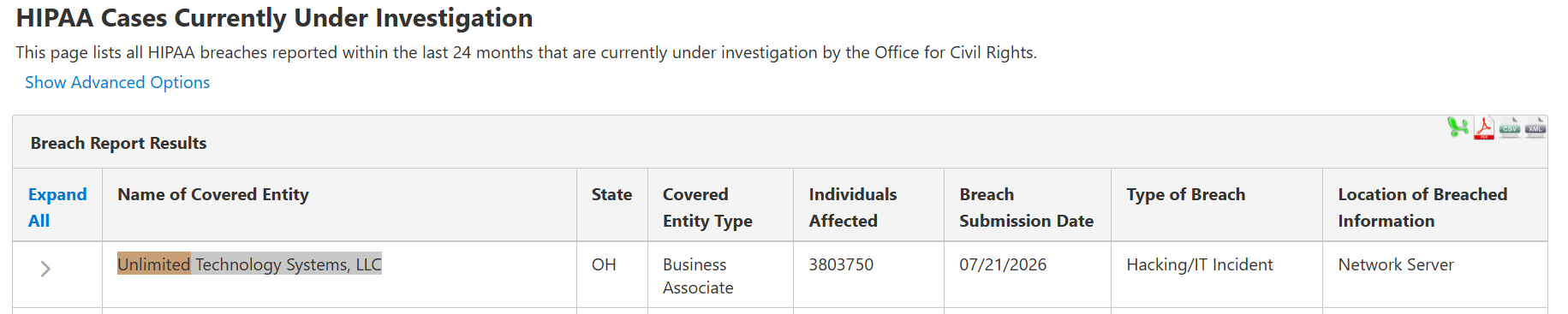
UNLIMITED Technology Systems, an Ohio‑based health‑care IT vendor, disclosed that a breach exposed the personal and medical information of approximately 3.8 million patients, according to securityaffairs.com. The company said the incident was identified after unusual activity was spotted in one of its hosted environments. It added that the breach did not compromise every record in its systems but still involved a substantial volume of sensitive details. Affected individuals are being notified by mail and offered support services.
The intrusion window ran from 5 October to 10 October 2025 and remained unnoticed until 19 October, when internal alerts prompted a deeper look. Investigators found that an external party had gained read‑only access to a storage cluster holding administrative files. The copied fields consist of full names, postal addresses, telephone numbers, e‑mail addresses, Social Security numbers, medical record numbers, diagnosis codes, service dates, insurance policy numbers and scanned images of documents such as explanation‑of‑benefits forms. Although complete clinical charts were not taken, the stolen data still enables identity theft and insurance fraud, as outlined by SecurityWeek.
Once the breach was confirmed, Unlimited Technology Systems contracted a specialist forensic team to trace the entry point and preserve evidence. The firm also contacted the Federal Bureau of Investigation and the state attorney‑general’s office to meet reporting obligations. Notification letters began arriving at affected homes within two weeks of the discovery, describing what information had been taken and what steps the company was taking. In addition, the vendor announced that it would provide two years of complimentary credit‑monitoring and identity‑theft protection to everyone whose records were accessed, according to the Iowa Attorney General’s notice.
No CVE identifier has been published for this event and law‑enforcement agencies have not yet attributed the activity to any known cyber‑crime syndicate or nation‑state group. The indicators suggest the intruder used valid credentials or exploited a weakness in a peripheral application rather than exploiting a core server flaw. Because the taken data consisted mainly of identifiers and billing information, the motive appears to be financial gain rather than espionage.
The case highlights how attackers increasingly target ancillary systems that store valuable personal data even when they do not hold full medical histories.
Organisations that manage health‑care information should review who possesses direct query rights to patient‑related databases and remove any accounts that are no longer required. Enforcing multifactor authentication on all remote‑access consoles and on privileged‑access workstations greatly reduces the chance that stolen passwords can be reused.
Network segmentation must be checked so that development, testing and production environments cannot talk to each other without strict controls, thereby limiting an attacker’s ability to move laterally. Finally, enabling detailed audit logs for data‑export commands and setting alerts for unusually large transfers helps detect exfiltration attempts early.
People whose data was included in the breach are encouraged to enrol in the complimentary identity‑protection programme being offered by Unlimited Technology Systems and to activate any credit‑freeze or fraud‑alert options available through the major bureaus. Regularly reviewing credit reports for new accounts or inquiries that they did not initiate can reveal misuse before it becomes serious.
Any unexpected communication that asks for personal details, whether by phone, e‑mail or text, should be treated with caution and verified through an independent channel before responding. Staying vigilant for signs of medical‑identity theft, such as unfamiliar claims on insurance statements, is also advisable.