Payloads · Insecure Direct Object Reference
Insecure Direct Object References
Insecure Direct Object References (IDOR) is a security vulnerability that occurs when an application allows users to directly access or modify objects (such as files, database records, or URLs) based on user-supplied input, without sufficient access controls. This means that if a user changes a par…
For testing systems you own or are authorised to test, and for defending them. Nothing here is run by this page.
From PayloadsAllTheThings by Swissky and contributors. MIT License, Copyright (c) 2019 Swissky. The repository.
8 of 8 passages
Passages
- Insecure Direct Object References
- Methodology
- Numeric Value Parameter
- Common Identifiers Parameter
- Weak Pseudo Random Number Generator
- Hashed Parameter
- Wildcard Parameter
- IDOR Tips
> Insecure Direct Object References (IDOR) is a security vulnerability that occurs when an application allows users to directly access or modify objects (such as files, database records, or URLs) based on user-supplied input, without sufficient access controls. This means that if a user changes a parameter value (like an ID) in a URL or API request, they might be able to access or manipulate data that they aren’t authorized to see or modify.
IDOR stands for Insecure Direct Object Reference. It's a type of security vulnerability that arises when an application provides direct access to objects based on user-supplied input. As a result, attackers can bypass authorization and access resources in the system directly, potentially leading to unauthorized information disclosure, modification, or deletion.
**Example of IDOR**:
Imagine a web application that allows users to view their profile by clicking a link `https://example.com/profile?user_id=123`:
<?php
    $user_id = $_GET['user_id'];
    $user_info = get_user_info($user_id);
    ...
Here, `user_id=123` is a direct reference to a specific user's profile. If the application doesn't properly check that the logged-in user has the right to view the profile associated with `user_id=123`, an attacker could simply change the `user_id` parameter to view other users' profiles:
https://example.com/profile?user_id=124
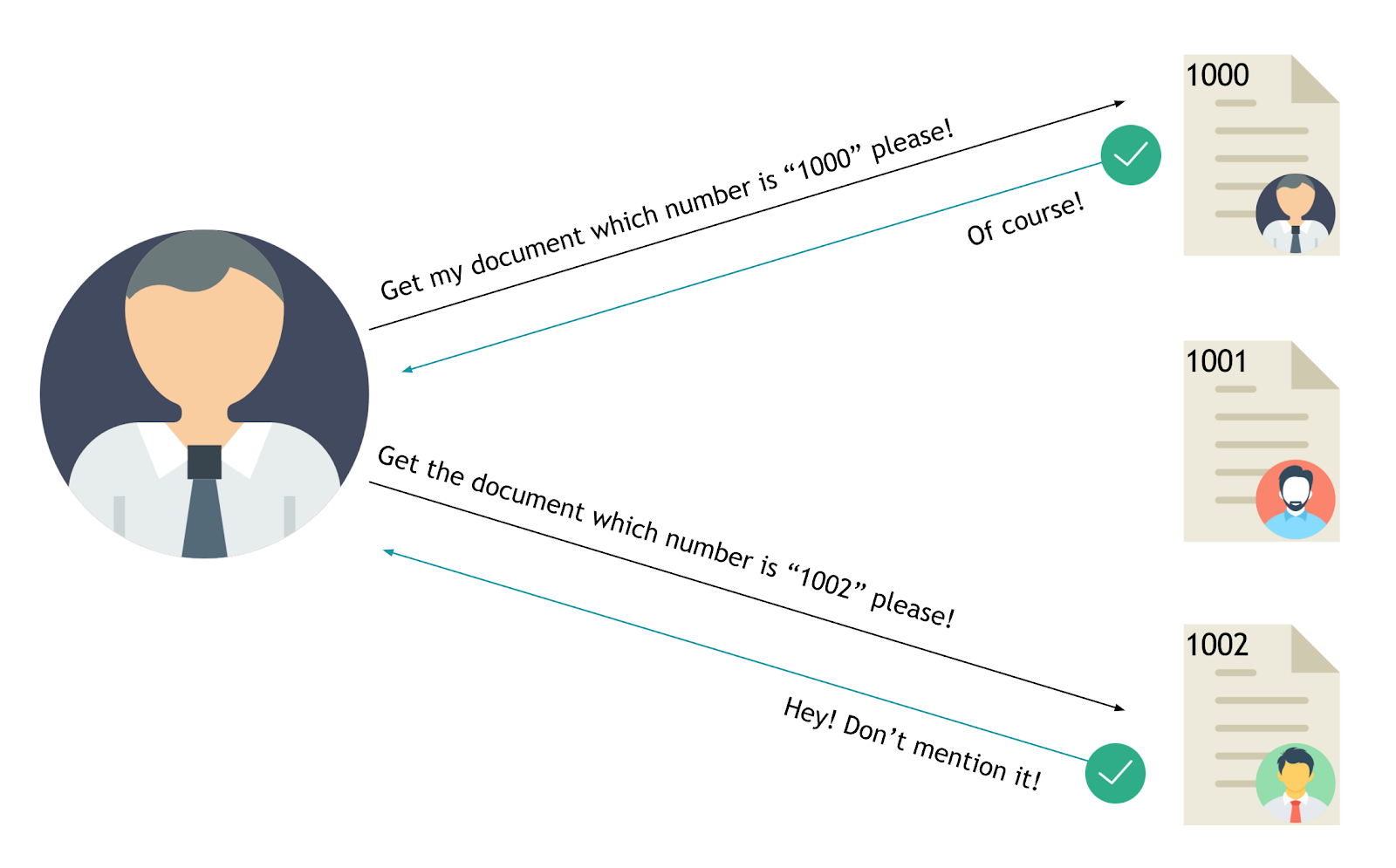
Increment and decrement these values to access sensitive information.
* Decimal value: `287789`, `287790`, `287791`, ...
* Hexadecimal: `0x4642d`, `0x4642e`, `0x4642f`, ...
* Unix epoch timestamp: `1695574808`, `1695575098`, ...
**Examples**:
* [HackerOne - IDOR to view User Order Information - meals](https://hackerone.com/reports/287789)
* [HackerOne - Delete messages via IDOR - naaash](https://hackerone.com/reports/697412)
Some identifiers can be guessed like names and emails, they might grant you access to customer data.
* Name: `john`, `doe`, `john.doe`, ...
* Email: `john.doe@mail.com`
* Base64 encoded value: `am9obi5kb2VAbWFpbC5jb20=`
**Examples**:
* [HackerOne - Insecure Direct Object Reference (IDOR) - Delete Campaigns - datph4m](https://hackerone.com/reports/1969141)
* UUID/GUID v1 can be predicted if you know the time they were created: `95f6e264-bb00-11ec-8833-00155d01ef00`
* MongoDB Object Ids are generated in a predictable manner: `5ae9b90a2c144b9def01ec37`
* a 4-byte value representing the seconds since the Unix epoch
* a 3-byte machine identifier
* a 2-byte process id
* a 3-byte counter, starting with a random value
**Examples**:
* [HackerOne - IDOR allowing to read another user's token on the Social Media Ads service - a_d_a_m](https://hackerone.com/reports/1464168)
* [IDOR through MongoDB Object IDs Prediction](https://techkranti.com/idor-through-mongodb-object-ids-prediction/)
Sometimes we see websites using hashed values to generate a random user id or token, like `sha1(username)`, `md5(email)`, ...
* MD5: `098f6bcd4621d373cade4e832627b4f6`
* SHA1: `a94a8fe5ccb19ba61c4c0873d391e987982fbbd3`
* SHA2: `9f86d081884c7d659a2feaa0c55ad015a3bf4f1b2b0b822cd15d6c15b0f00a08`
**Examples**:
* [IDOR with Predictable HMAC Generation - DiceCTF 2022 - CryptoCat](https://youtu.be/Og5_5tEg6M0)
Send a wildcard (`*`, `%`, `.`, `_`) instead of an ID, some backend might respond with the data of all the users.
* `GET /api/users/* HTTP/1.1`
* `GET /api/users/% HTTP/1.1`
* `GET /api/users/_ HTTP/1.1`
* `GET /api/users/. HTTP/1.1`
* Change the HTTP request: `POST → PUT`
* Change the content type: `XML → JSON`
* Transform numerical values to arrays: `{"id":19} → {"id":[19]}`
* Use Parameter Pollution: `user_id=hacker_id&user_id=victim_id`
Data as of 2026-11-14.